

In our earlier article (Business Antidote to Covid – adopt RPA!) we discussed about how RPA has become the most preferred choice among the organizations. With enterprise operations are becoming more and more complex, adopting the digital way of doing business was the only choice which meant more apps, devices, channels, data, and integrations to manage. Several organizations are already implementing AI and automation technologies like RPA, machine learning and cognitive AI to improve efficiency and simplify business workflows – which is a good thing. But the efficiency and ROI of these technologies will be much more if they are coupled together and are made to work with each other. Which brings us to Intelligence Process Automation (IPA).
Recent study by Pega finds that a majority of business leaders recognize intelligent automation as key means to simplify complexity and streamline operations. With technologies like RPA, AI, BPM, email bots, chatbots, and natural language processing combined on a scalable, low-code platform, intelligent automation can be pervasively applied throughout an organization.
Intelligent Automation is a combination of Robotics Process Automation (RPA), Cognitive Process Automation (CPA), and Artificial Intelligence (AI) that allows organizations to not only automate the human tasks but also help them in the decision-making process. Intelligence Automation is like the “Brain” of the system as it can imitate people, derive insights from them as they go, and, after some time, carry out certain responsibilities better than their humans. According to Forbes, Intelligent Automation increases execution capacity, minimizes the overhead needed to get services and products to market and optimizes efficiency by facilitating better-informed decision-making and a focus on quality.
The convergence of various domains of technologies is needed to produce automation capabilities that dramatically elevate business value and competitive advantage. According to a study conducted by McKinsey, several companies have managed to automate 50-70 percent of tasks with the help of IPA, in turn reducing the through-put time by 50 – 60 perfect and yielding an ROI in triple digit percentages.
Impact Across Industries
The key industries impacted by intelligent process automation are Financial Services and Retail. While the major impacted business units are Service Operations, HR, and R&D. By automating customer segmentation and core administrative functions using robotic process automation tools, both Healthcare Insurers and Financial services and Retailers see a rise in cross-selling efforts and improved customer satisfaction which in turn leads to additional revenue. Let’s see how intelligent automation is relevant to different aspects of a financial and retail industries.
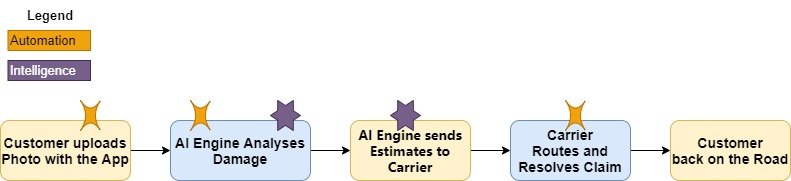
A leading player in the insurance sector has automated multiple steps in the claims process by combining bots and decision boards. Their current process had inefficient utilization of resources and a lot of scrutiny involved in processing the claims. These activities were costing the company, delaying the settlement process, and leading to low customer satisfaction as evident from C-SAT scores.
To automate their claim settlement in an intelligent manner, they identified all the bottleneck activities in each process. Repetitive tasks like data extraction from digitized documents were automated with the help of robotic process automation tools, while activities like workforce optimization were automated with custom-built python codes. They also added ML/DL techniques on top of the automated process for decision-making areas such as claims segmentation and fraud detection. This resulted in reducing the decision-making time of the assessor by 75%, which is an improvement in the existing fraud detection system by 50% and incurred a savings of around $18 Million. The current ‘intelligent automated’ process looks like this:
- Customer Engagement and Brand Recall
IPA helps to reach out to every customer with a personalized message and customized offers. This would be a herculean task if done manually. It would require hiring more staff, training them for the task and giving them salaries regularly. Intelligent process automation does not only take care of these incremental expenses, but it also does the work with utmost diligence. Couple of simple examples of how IPA could improve the customer experience:
Automated messages to new and existing customers, tracking customers’ preferences, and making the brand visible to them on social media and other digital platforms are also carried out using Artificial Intelligence and Machine Learning.
- Better Data-Driven Planning
By introducing IPA into the supply chain and distribution network, retailers can gather crucial insights about inventory requirements at different locations and different times of the month or year. This helps them in planning their inventories in advance and source only what they need, thereby reducing wastage. Moreover, retailers can use geographical and seasonal data on sales to plan new store openings and seasonal campaigns or product launches. Automation, in short, enables efficient investment of resources into avenues that have been demonstrated, by data, to have a high likelihood of success.
Conclusion:
IPA – Intelligent process automation has the potential to make business processes smarter, swifter, and more responsive. It enables human resources to be more efficient. Sooner or later every business organization that wants to evolve with time will have to embrace this technology. The good news is that gradually, more and more business heads and CIOs are waking up to the virtues of IPA and embracing it for their businesses. No-code intelligent automation platforms give firms the flexibility they need to set up their automation solutions and drive forward the digital transformation and ultimately deliver enterprise-wide intelligent automation.
#IPA #RPA# CPA #AI #ML #NLP #RoboticProcessAutomation #Automation #Robots #Futureofwork #Technology #Digitaltransformation #RAS #MicrosoftPowerAutomate #UiPath #Pega #Lowcode #Nocode
#Strategy #Management #Consulting #Transformation #Technology #Outsourcing #CreativeDisruptions #EternalQuest #FindingTruth
 Randomness Pattern
Hey, great read! I particularly enjoyed your in-depth discussion of data-driven planning, since it was something I hadn’t really thought of before. Being a fellow tech blogger myself, I also really appreciate how organized and well-formatted everything was – it definitely made the content much more digestible overall. Keep up the awesome work!
LikeLike